New vocabulary
Spot (small) cards = 10, 9, 8, 7, 6, 5, 4, 3, 2.
Length Trick (LT) = a small card that wins a trick because all other cards are out of the game.
Trump = a card in the suit that was chosen as trumps in the bidding. It beats the other cards.
Distributional Trick (DT) = a trick won by a small card.
Short side = a hand with fewer cards in the suit of the partnership
Long side = a hand with more cards in the suit of the partnership
Watch the video lesson first
Key facts to remember
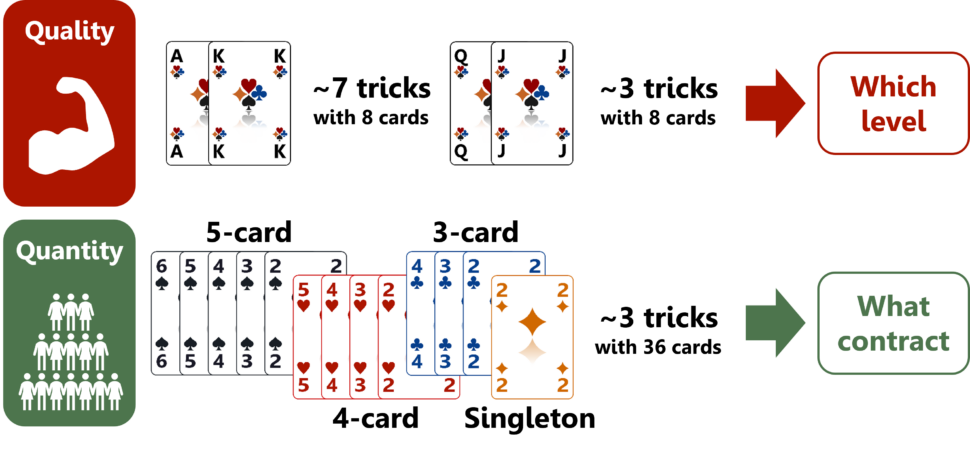
- The quality of your cards determines the contract LEVEL.
- The quantity of your cards determines the contract TYPE.
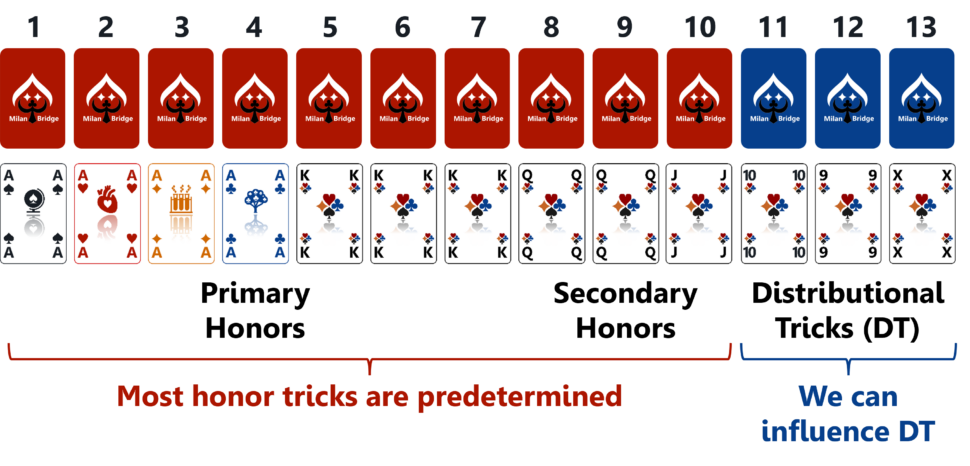
- Most Honor Tricks are predetermined, but we can influence the distributional tricks.
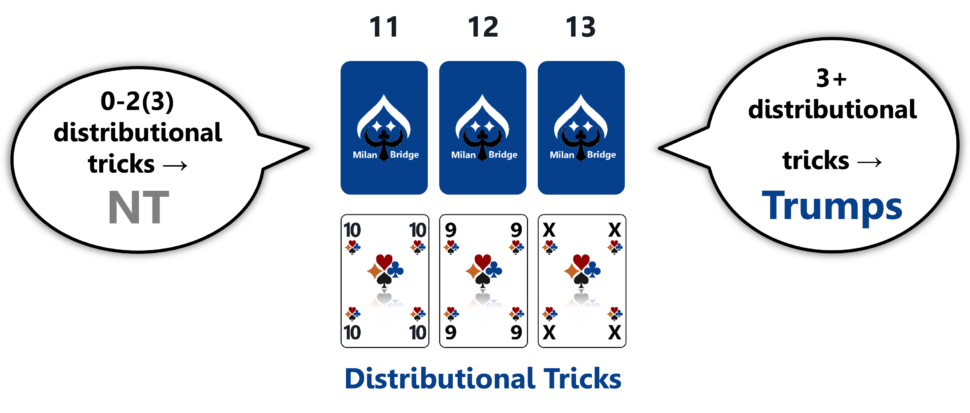
- A few distributional tricks: 0-2(3) means we should play NT contract; 3+ DT will more often bring a higher score in trump contracts.
- 3 types of distributional tricks: Length Tricks, Trump Tricks, and Middle Cards.
- Distributional tricks, basic card play techniques, and basic defensive strategies are closely connected.
Lesson overview
Distributional tricks determine who wins
In the introduction video, we learned that the quality of our cards determines the level of the contract. We also learned several methods for assessing the strength of our hand.
Now, it is time to look more closely at the number of cards in each suit and how the quantity influences the game.
Besides the contract level, we must decide which contract type to play: NT or Trumps.
We also learned that honors most often win 10 tricks, and that we win the remaining 3 tricks due to our distribution.
We cannot influence the distribution of top honors, but we can influence the bidding and determine which small cards will be more valuable by setting a particular suit as trumps.
- The distributional tricks are key to winning in bridge. If you understand the usefulness of long and short suits, you will be unbeatable.
- If we simplify the choice of the contract, you should play NT if you win only a few tricks with your small cards. That means the honor strength determines who wins more tricks and, therefore, the bidding.
- If we win 3 or more tricks with our small cards, we achieve a higher score in a trump contract.
- We can win the bidding even with fewer honors because we win more distributional tricks. This is particularly useful if you can deliberately overbid the opponents and achieve a better negative score; we call this strategy sacrificing.
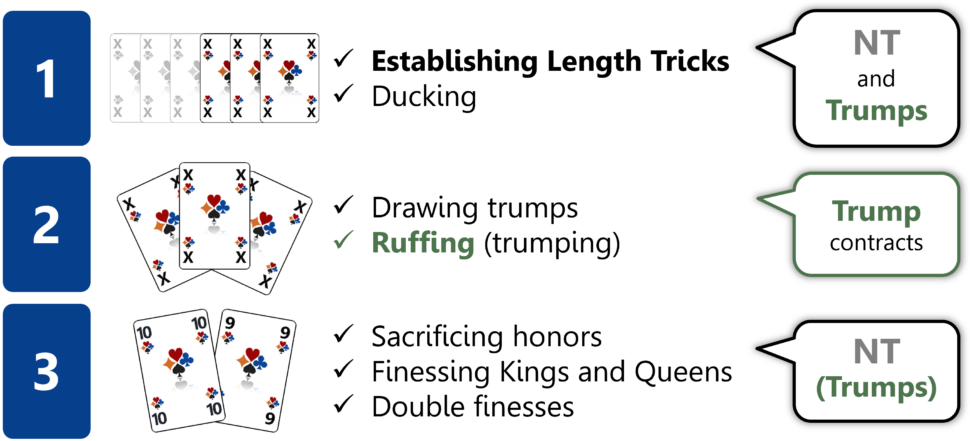
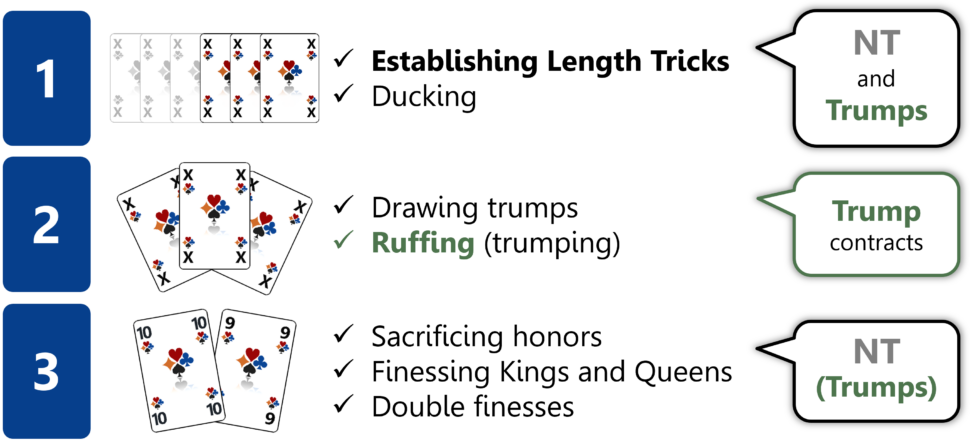
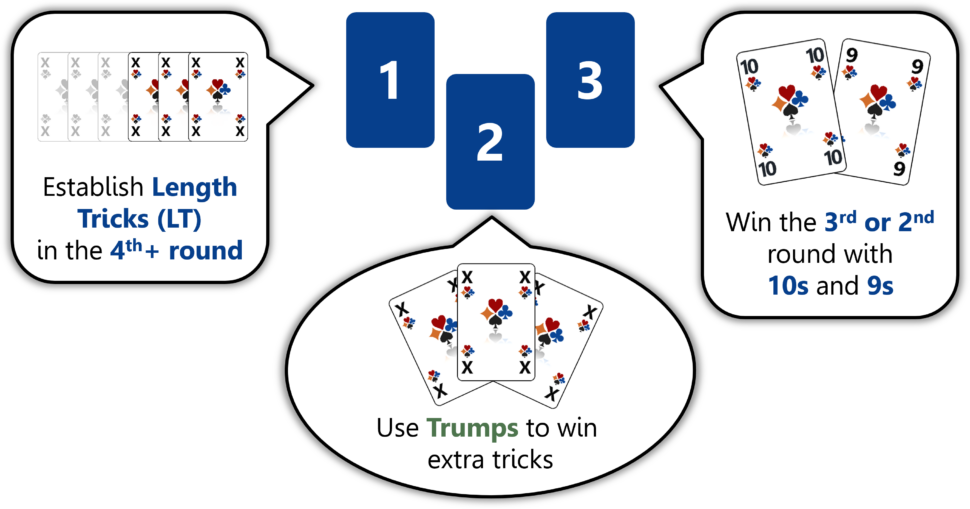
There are 3 ways you can win distributional tricks:
- The most common strategy is to establish your long suit by playing the suit at least 3 times. This strategy, called establishing length tricks, is the most important card-play strategy in bridge. You should use it both in trumps and NT contracts, and as a declarer or a defender.
- The second common strategy is to win tricks with small trumps. While some of the trump tricks are natural winners because they become length tricks sooner or later, we can use trumps to beat the opponent’s high cards and gain an advantage in the game. To do that, we must understand the significance of short suits.
- The last option is to catch some of your opponents' honors and win tricks with your middle cards: 10s and 9s. This strategy is more difficult and needs advanced card-playing skills.
All our lessons are connected, and evaluating the distribution is closely tied to several essential card-play techniques, as well as first-lead strategy and signaling.
- Establishing Length Tricks is absolutely fundamental in bridge. Don’t go any further until you completely understand the principle.
- The counter-strategy to length tricks is ducking.
We can use both techniques in all contracts.
We cannot win trump tricks in NT contracts, so consider wisely which contract to choose to maximize your score.
- Drawing trumps is a routine play.
- You have to learn when to do it as your first step and when to postpone it, but the technique is the same as establishing Length, just in a specific suit.
- The essential technique to learn in trump contracts is beating the opponent’s high cards with our small trumps. In bridge slang, we use the term ruffing or trumping.
- There are more advanced techniques for using trumps to your advantage, but start with these two essential ones.
Winning our middle cards is not easy and depends on card-play skills like sacrificing honors or catching the opponent’s honors, so-called finessing.
- It is more likely we win these tricks in NT, but the middle cards may play a significant role in the trump suit or one of the sidesuits.
- Evaluating and playing with middle cards is part of the advanced course.
Now is the time to dive deeper into learning the key techniques.