Learn the fundamental knowledge
- Understanding the fundamentals of any game or activity is vital to making progress as quickly as possible.
- In bridge, understanding the value of cards and how they contribute to winning tricks is fundamental.
- It starts with evaluating the strength of your cards: Honor Tricks and Distributional Tricks.
- Hand evaluation is closely connected to basic card play techniques: Cashing winners, Sacrificing honors, Finessing, Drawing trumps, Ruffing, and defensive strategies like Positional play and First lead strategy.
- It continues with deciding which contracts to play: Hand orientation, Strength Ranges, Deal balance, and basic bidding structure.
Why should you take this course?
- This course is essential for every bridge player. It will teach you how to make all your decisions measurable, progress faster, and start winning sooner and more often.
- This course is a must for anyone new to bridge. But it will help you if you return after a longer break.
- You should take this course if you were taught the old-fashioned, difficult way – counting High Card Points and remembering the rules and guidelines.
- Repeat this course periodically to master all fundamental skills. It will save time and energy, allowing you to invest in more advanced skills.
Watch the video
Lesson content
Start with the fundamentals and build your knowledge
In every activity, it is essential to start with the basics and understand the elementary moves and techniques.

In every activity, it is essential to start with the basics and understand the elementary moves and techniques.
In bridge, the most important skill is properly evaluating your hand and understanding how winning tricks affect the final score.
You must then choose the best strategy with your partner relative to your combined cards.

The biggest difference between bridge and other mind games is that each deal starts with a different hand.
Each player holds 13 cards, so at the beginning we know only ¼ of the deck. The remaining cards are hidden from us, and our goal is to disclose them during the game.
The initial card distribution determines each player's and partnership's bidding strategy. The final contract then determines the card play strategy.
Everything is connected!
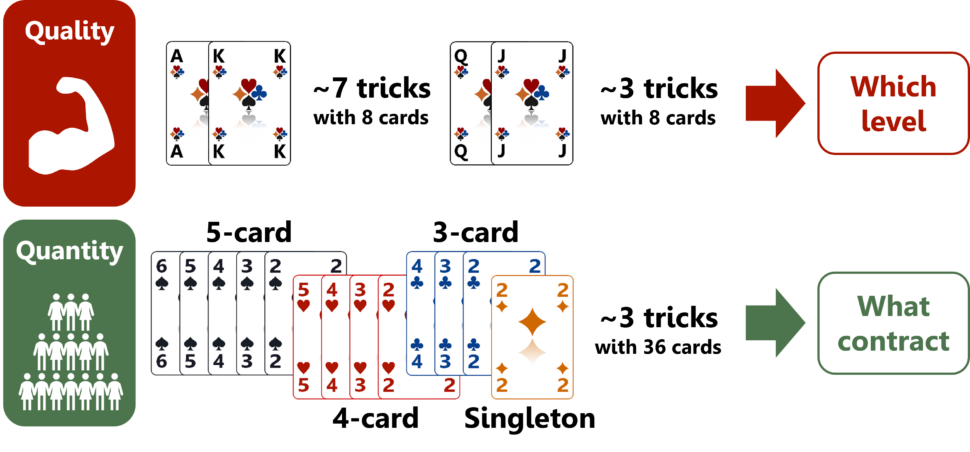
There are several methods for evaluating the hand, but all should determine the quality and quantity of the cards.
- By quality, we mean how good our cards are: Aces and Kings win the majority of tricks, usually 7. Queens and Jacks are often covered by aces and kings, but 3 out of these 8 cards usually win a trick.
While aces and kings win tricks regardless of the contract, queens and jacks change their value already during the bidding.
- By quantity, we mean how many cards we have in each suit. Winning a trick with a small card depends on the card play strategy of both partnerships.
Most often, 3 small cards win a trick if the cards are distributed more or less evenly among all players.
The more cards we have in one or two suits, the more tricks we can win with them, especially if we choose one of the long suits as trumps.
To sum it up, the quantity influences which contract to play (trumps or no trumps), and the quality determines the level of the contract.

- All bridge skills depend on a proper hand evaluation.
- The better you understand the strength of each card, the better you can estimate which contract to play.
- Make your decisions based on facts and measurable data.
- Good fundamental skills lead to faster progress and winning sooner and more often.
- Mastering the hand evaluation will save time and energy, allowing you to invest in more advanced skills.