Introduction to evaluation of Honors
Watch the video lesson first
New vocabulary
Honor = Ace, King, Queen, Jack
Primary Honor = Ace & King
Secondary Honor = Queen (Jack)
Distributional tricks = tricks won with small cards, often trumps
Key facts to remember
- There are 13 tricks in the game.
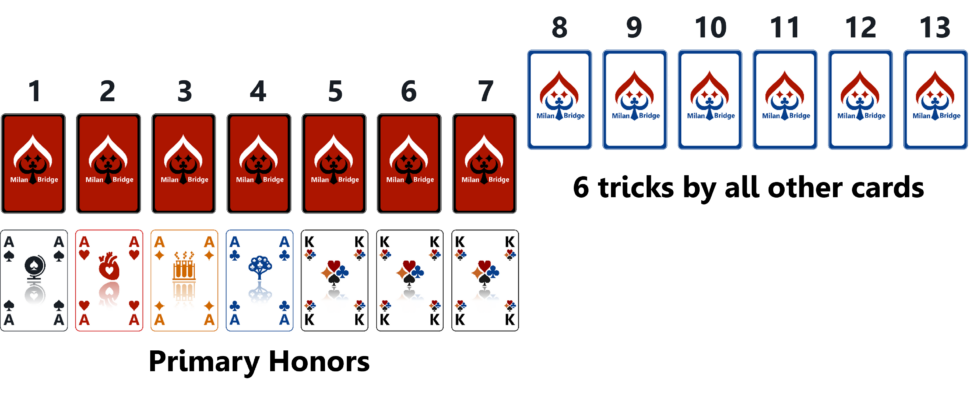
- Aces and Kings win the majority of tricks, usually 7, and we call them Primary Honors.
- Queens and Jacks win on average 3 tricks, and we call them Secondary Honors.
- The remaining 3 tricks are won by small cards, and we call them Distributional Tricks.
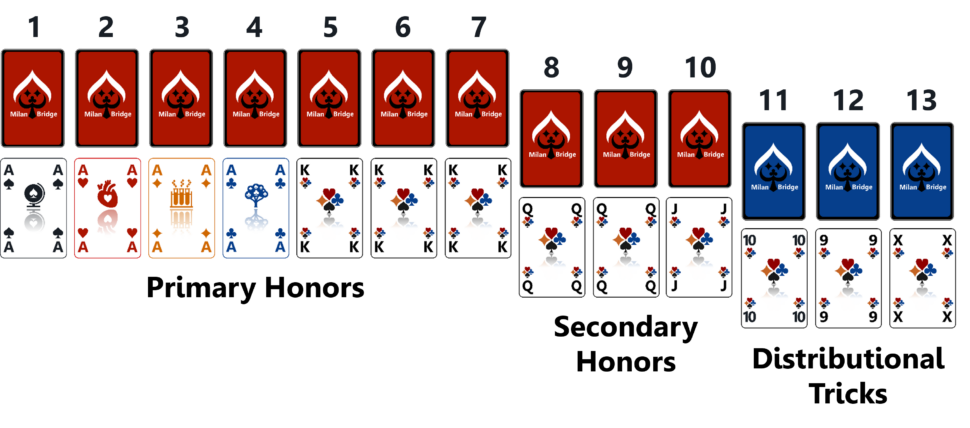
Lesson overview
The deck of 52 cards is distributed among 4 players
Before the start of the game, each player must count their cards before looking at them.
We call one player’s cards a "Hand".
Your first task in each game is to sort the cards by suits and ranks.
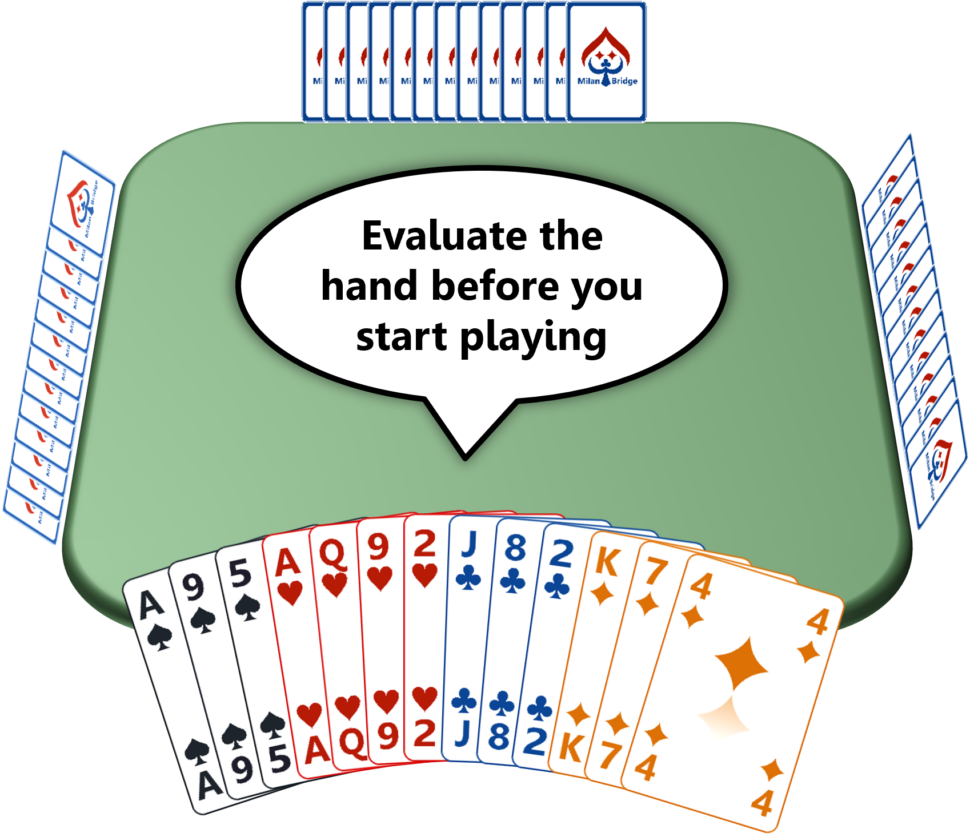
I recommend alternating dark and light colors.
Before we learn how to evaluate the hand, we must understand the game:
- Bridge is a game of tricks, and each player contributes one card to each trick.
- Players play cards one after another in a clockwise direction.
- The highest card wins the trick
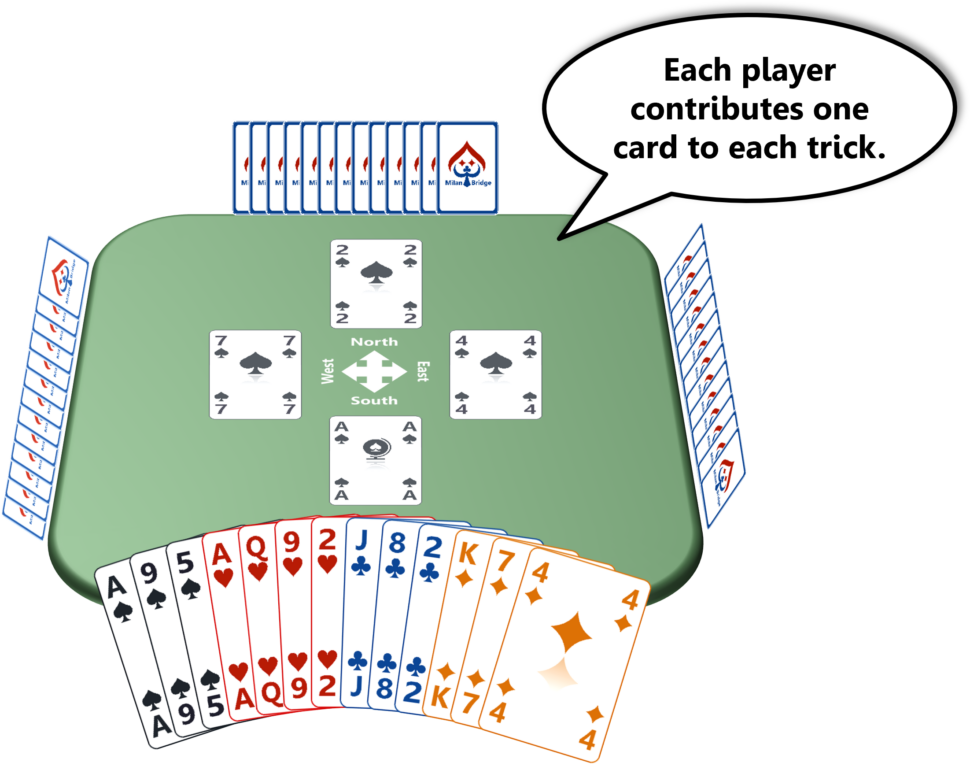
- There are 13 tricks in each game.
- The key to good hand evaluation is understanding how each card contributes to winning tricks.
- Aces are the highest cards in the game, and they guarantee the trick unless they are trumped.
- Aces win 4 out of 13 tricks.
- Kings are the second-highest cards and win a trick unless they are taken by the opponent’s ace or trumped.
- We expect that on average, 3 kings win a trick.
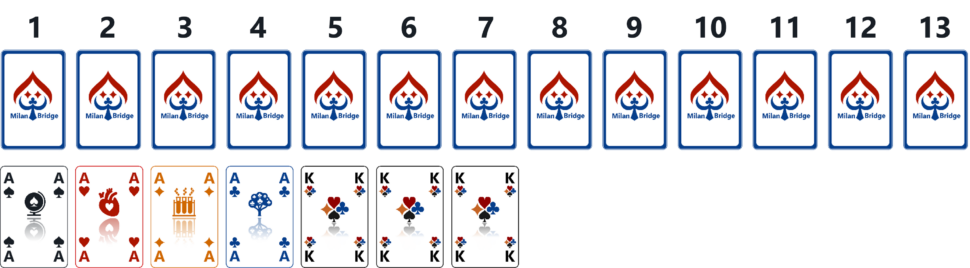
- Aces and Kings win the majority of tricks.
- We must therefore give them the highest value.
- Because of their significance, we call Aces and Kings “Primary Honors”.
- The remaining 6 tricks are won by all other cards.
- The majority of tricks are determined by who holds the aces and kings, but the remaining 6 depend on the type of contract and the players' strategy.
- Half of the remaining tricks are most often won by smaller honors – Queens and Jacks.
- We call them “Secondary Honors".
- They have a higher chance of winning a trick if they are connected to an Ace or a King.
- But on average, Queens win 2 tricks and Jacks 1 trick.
Based on this fact, we can presume that honors win 10 tricks on average. Sometimes you win 4 Kings and only 1 Queen; sometimes more Jacks than Queens, but the total is most often 10.
The remaining 3 tricks belong to all other cards, most often trumps, middle cards (10s and 9s), or small cards that become highest due to various card-play techniques.
We call these cards “Distributional Tricks,” and I will talk about them in the following lesson.