Conventions
Helpful tool or a dead weight?
Bridge conventions may improve your decision-making in the bidding. It may increase your options and help you to find a better contract.
But they can also create confusion, make the system difficult to remember, and some conventions might even make your system less effective compared to a natural bidding system.
Which conventions are good and you should start using, and which are unnecessary overburdens and you should avoid? Join our academy and improve your skills and results by using only the good ones.
Watch the video lesson
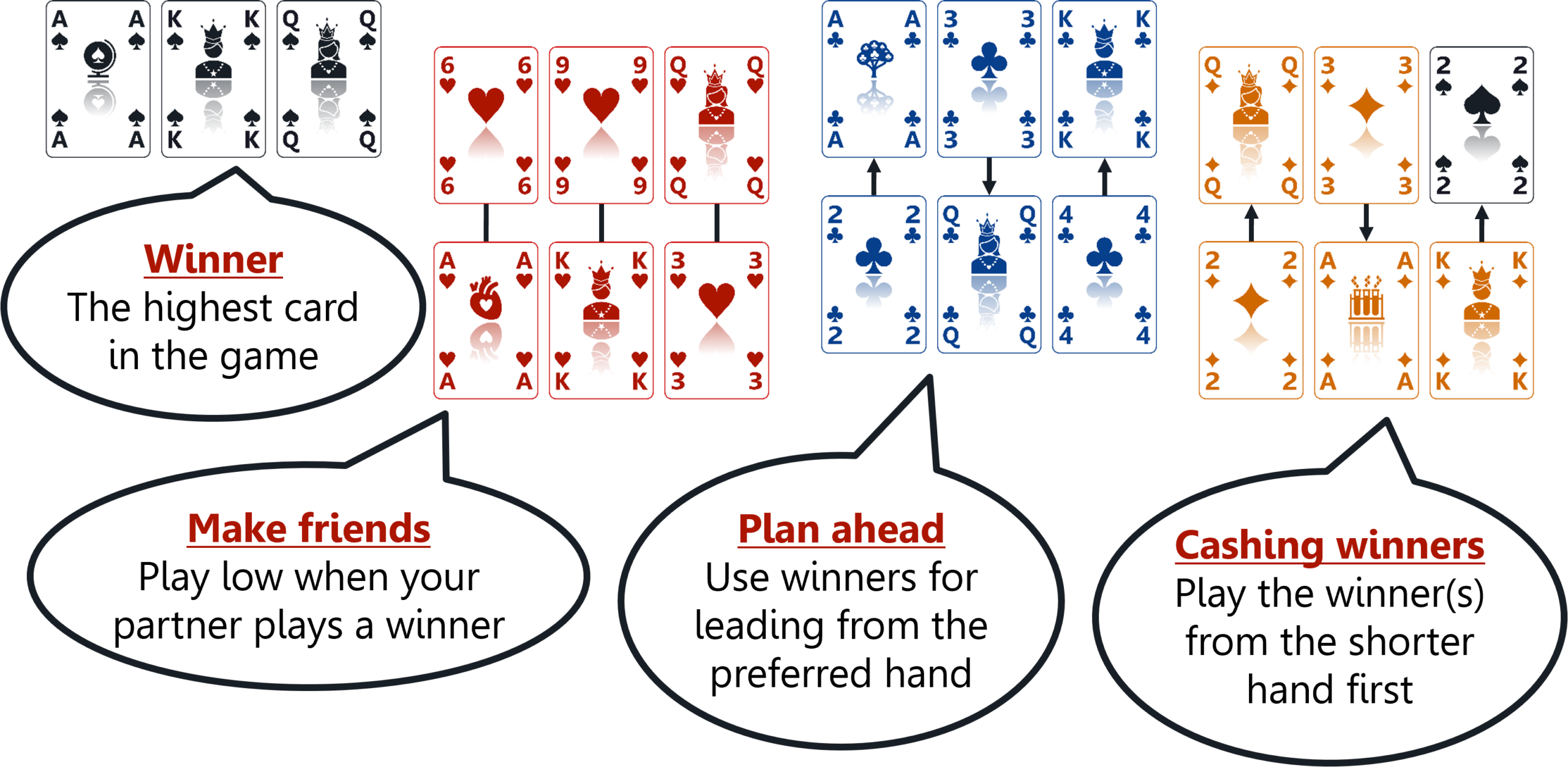
Play your first hands
Task: Make all 13 tricks.
Lesson overview
What is a convention in bridge?
A convention is a bid or sequence of bids that shows specific information that does not say anything about the suit you bid, and that does not offer the bid as a final contract.
These bids must be ALERTed to inform opponents of a non-standard meaning.
What a good convention must fulfill?
A good convention must improve your bidding or your choice of the final contract compared to the natural bidding.
It must:
- Improve your decision-making due to a more specific hand description – exchange information that helps.
- Place the declarer at a better advantage to increase the chances of making the contract – position the declarer to protect your honors/key suit.
- Allowing you to show more hands on a lower level – keep all options open.
- Make it clearer what your intentions are – straightforward is better, avoid either or.
- Be frequent and easy to remember – easy and logical is better.
- Possible to use it in more sequences – the more the better.
- Do not disclose unnecessary information to opponents – sometimes less is more.
How to find out if the convention is good for you?
It takes a lot of experience to put together a comprehensive and effective system. We do not recommend putting a single convention in your system if you are not sure what it affects. Some consequences might not be clear at first sight. Some conventions work together as a whole and complement each other. It is better to play the system as it was written by a professional – avoid changing only parts of it.
Frequency
How often do you use this convention? Do you have to repeat it before every game, or does it come so often that you learn it by playing? Does your partner remember it? Do you risk a disaster if one of the players forgets?
Versatility
Can you use the same convention in more sequences? Does the meaning correlate to your general bidding strategy? Do you have to sacrifice other useful bids to play the convention? Is it immune to doubles or overcalls? Do you have an escape plan if something goes wrong?
Effectivity
Do you reach an optimal result because of this convention? Do you spend memory capacity in proportion to the score gain? Does the convention have a logical structure? Is it easy to remember? Does the convention make your decisions easier and more precise?
We can divide conventions into several groups
Must play
Conventions that are generally used, come up frequently, and improve bidding significantly (transfers, splinters, relays). The investment in their learning is beneficial in proportion to the difficulty vs. the score improvement. Some conventions work together as a "full package" that solves the complete bidding (invitational jumps, limited inverted minors, 2NT as a Major raise).
List of "Must play" conventions
Show more conventionsShow lessFor long-term partnerships
Some conventions are more difficult to remember, or you need more memory capacity to play them. They can be beneficial to play if they are practiced and played long-term to avoid unnecessary mistakes. There may be various alternatives that can lead to misunderstandings in occasional partnerships.
List of conventions for long-term partnerships
Show more conventionsShow lessNeutral
There are conventions that do not bring a long-term score improvement, but do not do any harm if you include them in the system. They may be fun to play, with no additional system change needed. They can be easily exchanged for a natural bidding. They may also produce different results depending on the strength of the field or the opponents. Most often, special 2 or 3-level openings.
List of "Neutral but fun" conventions
Show more conventionsShow lessMisused
Conventions that have a good purpose, but are wrongly described or not used to their full potential. Often, a description does not help in further decision-making or says nothing extra.
List of "Misused" conventions
Show more conventionsShow lessNo added value
Some conventions solve some bidding problems but create others, or take bids that may be useful. They can work well in certain deals, but lose in others. There is no significant reason to play them because of the score or system improvement.
List of "No added value" conventions
Show more conventionsShow lessTry to avoid
These conventions do not improve your bidding. Although they might improve bidding with a certain type of hand, they will use bids that are more useful for other hands that are much harder to substitute. There are also conventions that need other conventions to solve the issues. Some conventions are against the general strategy of positioning. Altogether, they only make the system more difficult with no true long-term benefit.