Lesson 3
Player's roles – playing with a dummy
Glossary
Contract = xxx
Key facts to remember
- ...
Download the lesson and materials
Part 3: Player's roles
So far, you could play without the dummy. That means that all 4 players play with their cards and none of them are disclosed. This is not how Bridge is played.
In Bridge, one of the players puts his/her cards on the table after the first lead. We call this player the Dummy. His/her partner is in charge of the dummy's cards and calls which of them should be played. We call this player the Declarer.
Who is the Declarer and who is the Dummy?
In our simplified version of bridge (mini-bridge), the stronger player in the partnership that sets the contract becomes the declarer, and their partner becomes the Dummy. If both players have the same strength, the dealer or the player in play behind the dealer becomes the declarer.
The opponents become the defenders. The defender sitting to the left of the declarer leads to the first trick. After the first lead, the Dummy puts all the cards on the table face up so everyone can see them.
The contract determines the number of tricks each side must take to win.
Step 1: Evaluating the hand
Before the game starts, we must determine the strength of each player's hand and then the strength of each partnership. We call this procedure "Evaluating the hand". There are many methods for doing it.
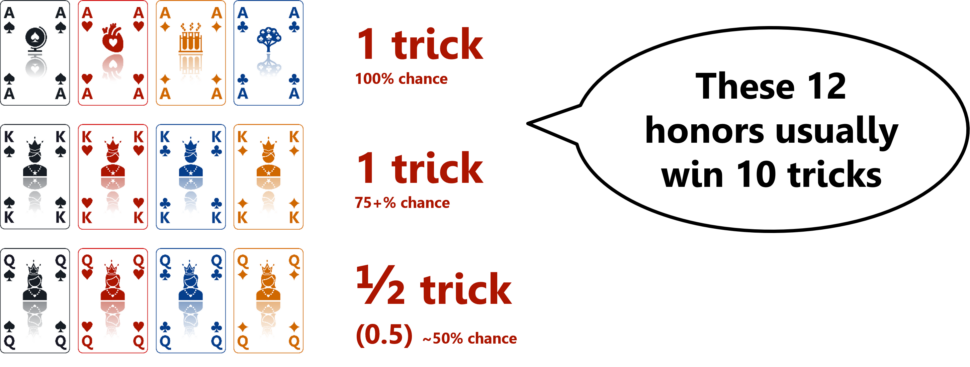
Logically, high cards (honors) win the majority of tricks. We can therefore assign a specific value to them and compare which partnership has better cards and by how much.
Top Honor Trick method (THT)
The easiest yet highly efficient method, even experts use, is to count each Ace and the King as 1 trick, and the Queen as half a trick. This theory is based on practical experience. Because there are 4 cards of each rank, the total value of these 12 honors equals 10 tricks (4 aces + 4 kings + 4*0.5 queens). We call this method counting Top Honor Tricks (THT).
The remaining 3 tricks are won by all other cards, and we give them no value. The stronger side usually has an advantage, so we expect them to win 2 out of those 3 tricks if we play without trumps.
Step 2: First decision table
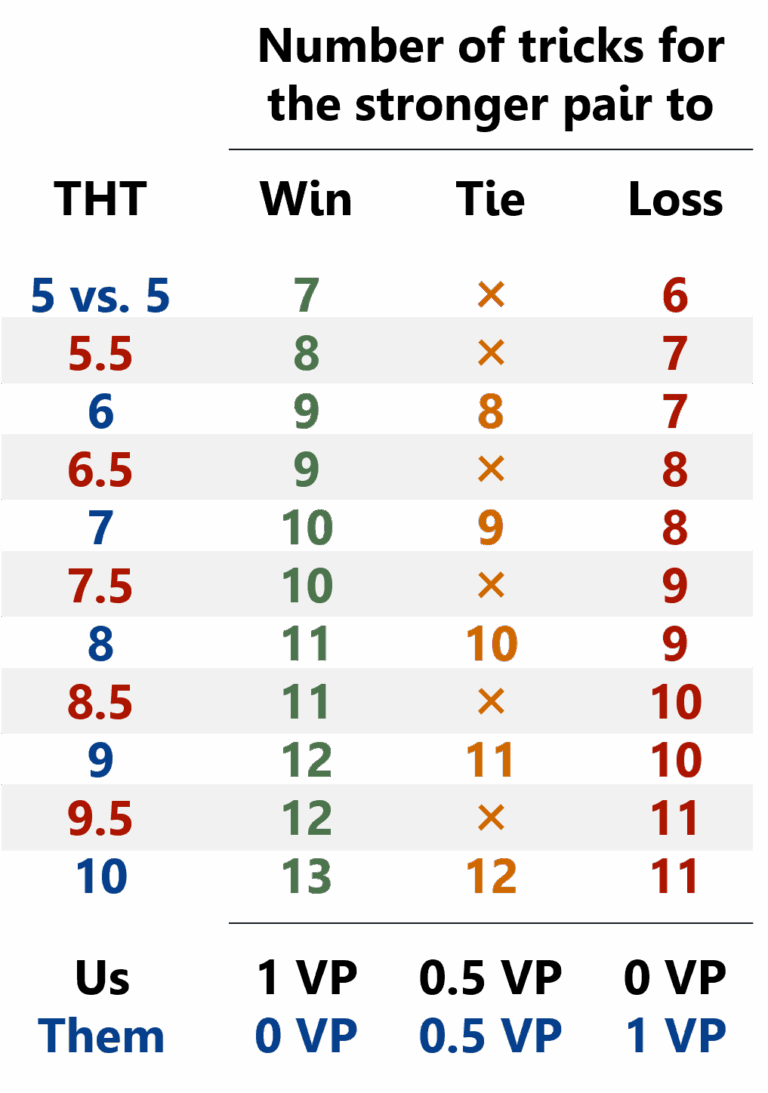
Before we learn the complete procedure for setting up the contract, we can use the following process to determine the contract (the goal for each side) and the winner.
Setting up your first contract
- Each player counts the value of their hand in Top Honor Tricks (THT) and announces it to the other players. The Dealer starts first, and the other players go clockwise.
Fast check: the total must be 10. - We determine the strength of each partnership. The stronger pair will win the contract.
Note: if both pairs have 5 THT, the pair with the dealer wins the contract. - We add 2 tricks to the higher number of THT, and this determines the contract.
- If the number of tricks is rounded (7, 8, 9, 10, ...), we evaluate the hand as:
a win (1 victory point, 0 victory points for the opponents) by taking more tricks than the contract.
a tie (0.5 victory point for each pair) by taking the exact number of tricks as the contract.
a loss (0 victory points, 1 victory point for the opponents) by making fewer tricks than the contract. - If the number of tricks is partial (7.5, 8.5, 9.5, ...), we determine only a win or a loss if the pair takes more or fewer tricks than the contract. There cannot be a tie since there are no half tricks.
Playing without the Dummy
4 practice deals with various contracts
Goal: make the contract
Learned everything? Time to test your knowledge!